The Star Anchor: How to Own a Space in Someone's Mind
September 29, 2026
By Howie Chan
People don't choose the best. They choose what they remember.
Picture two T-shirts. Same color. Same fabric. Same thread count. Same fit.
One has a Nike swoosh on it. The other doesn't.
Which one do you pick?
You already know. And it has nothing to do with the shirt.
That little swoosh does something powerful. It pulls up every story, every ad, every belief you've ever stored about Nike. In a split second, your brain does the work. You don't compare. You don't research. You just choose.
That's what a brand really is. A brand is a memory that shortcuts decision-making.
It doesn't live in your logo, your website, or your LinkedIn headline. It lives in one place only: the mind of the people you want to serve. It's not what you say about yourself. It's what they remember about you.
This is true for Fortune 100 companies. It's just as true for you as a leader, a founder, or an expert.
Most people don't have an expertise problem. They have a memory problem. And a memory problem is an authority problem. If people can't remember you, they can't trust you. If they can't trust you, they won't choose you.
So the real question is simple: How do you become the one they remember?
Over the years, I've used one framework with some of the world's biggest brands, and with executives and founders building their reputation. I call it the Star Anchor. Here's how it works.
Two forces decide whether you're remembered
Positioning sounds like marketing mumbo jumbo. It's really not. Your position is a space in someone's mind that you own. It sits right where your world meets theirs.
Two forces decide if you ever get that space: relevance and difference.
Relevance is about them. Imagine you're in a loud bar. You're tuned out. Then someone across the room says your name. Your head snaps around. Why? Because it's about you. The brain pays attention to what touches its goals. If your back hurts and you see a headline about back pain, you stop scrolling.
Difference is about the brain's autopilot. Your brain is about 2% of your body weight, but it burns about 20% of your energy. So it tries to save energy all the time. It predicts. It skims. It runs on cruise control. The only way to break through is to be unpredictable. To stick out.
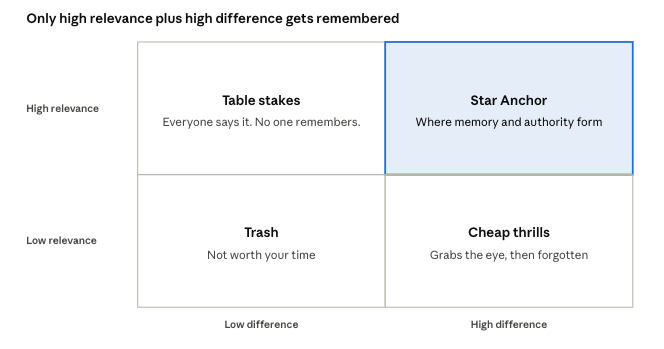
Put those two forces on a grid and you get four places you can stand:
Trash (low relevance, low difference). Not worth a second of your time.
Table stakes (high relevance, low difference). Everyone says it. Nobody remembers who said it first.
Cheap thrills (low relevance, high difference). Clickbait. It grabs the eye, then the brain says, "Not for me," and moves on.
The Star Anchor (high relevance, high difference). This is where memory forms. This is where authority is built.
Most experts live in table stakes. They're relevant, but they sound like everyone else. So they get nodded at, then forgotten.
Not sure which box you're in? Grab my Professional Brand Checklist: 66 decisions and assets that turn what you know into what you're known for. Score yourself across eight sections and see which part of your foundation needs attention first.
Relevance: Stop picking people. Start with the trigger.
Here's where many of my clients get stuck. They tell me, "Howie, I serve lawyers, CPAs, and real estate agents. How do I pick just one?"
You don't have to pick.
The old way is person first. Choose a job title or an industry, then ignore everyone else. It feels safe. It also leaves money and opportunity on the table.
The better way is what I call trigger first.
A trigger is the moment right before someone stops what they're doing and starts looking for help. That's when they are most open to you.
I learned this the cold way. I live in Minnesota. One Christmas Day, about six or seven years ago, my heat broke. Everything was closed.
I didn't search for the best HVAC company. I searched for who was open right now. I found one. They showed up within an hour, fixed it, and left. I paid a lot. I didn't care.
That's a trigger. It changes what people look for, and what they're willing to pay.
Here's how to use it:
List the triggers. What happens in your customer's world right before they look for someone like you?
Rank them. Which ones are the most painful, the most urgent, and the most worth paying for? Group the ones that are related.
Find who has them. Now look at the people who feel that trigger. The lawyer, the CPA, the real estate agent. These become your personas.
Name the dream outcome. What does each of them want on the other side?
Say you sell life insurance. The trigger might be: "My high-net-worth client needs new coverage, and I'm not sure where to send them." That trigger is your headline. The lawyer persona lets you go deeper, with their words and their world.
The trigger is the push. The dream outcome is the pull. Push plus pull is what moves people to act.
One more thing. I say customer, not audience. A customer trades with you. Money, time, or attention. An audience has no stake in you. Build for the people who trade.
Difference: Find what everyone else won't say
If you tell me, "Howie, I don't have any competition," I'll tell you you're wrong. I rarely say that with 100% certainty. Here, I do.
Competition is anyone or anything your customer reaches for other than you.
There are three kinds. Take a Snickers bar:
Direct: other candy bars.
Indirect: other snacks.
Alternative: something else entirely, like a drink.
Make a list of all three. Then go study them. Their websites. Their social channels. Their talks. Ask two questions:
What are they all saying and showing?
What are they all not saying and showing?
The second question is where your opportunity lives.
Why "saying and showing"? Because people take in both words and images. So build two tools. A bad words list: the phrases everyone in your space uses, which you'll avoid. And an opportunity board: the colors, images, and ideas nobody is using, which you can own.
One of my favorite examples is Billie, a women's shaving brand. They noticed something odd. Every razor ad for women showed smooth, perfect skin. Not one showed actual hair. Billie did a full 180. They showed the hair.
Did it look strange? Yes. That was the point. It broke the pattern. It woke the brain up from autopilot. And that's how they earned attention in a crowded category.
The same goes for you as a leader or expert. If every consultant in your field says "results-driven" and "strategic partner," those are your bad words. Your authority starts where their script ends.
Want to put this into practice? The Professional Brand Checklist has a full section on defining your position: mapping your direct and indirect competitors, and naming the phrases that have become noise in your space.
The Star Anchor: Where memory forms
When you know your customer and your competition, you can land in the top-right box. High relevance. High difference. I call this your Star Anchor.
Why an anchor? Because your one job is to anchor into memory. That's it. That's the whole job of a brand.
When you give people something relevant and different, the brain builds new connections. Do it again and again, and those connections get stronger. You're literally changing how your customer's brain is wired around you.
A strong Star Anchor needs two things:
A point of view. Not an opinion. An argument that changes what people believe. Think of Simon Sinek's TED Talk: people don't buy what you do, they buy why you do it. That wasn't a fact. It was a belief shift.
A memorable idea. A short handle people can carry. "Start with why" is that handle. Without one, people have to remember your whole story. They won't.
Expression: How you show up, again and again
A Star Anchor that stays in your head does nothing. Expression is how you put it into the world. Before you do, lock in two rules.
Alignment. Every touchpoint must tell the same story. The ad, the first email, the product, the follow-up. When the experience is all over the place, memories stay shallow. When it all lines up, the grooves get deep.
Repetition. Say it a hundred times. A thousand. A million. There's a well-known finding called the mere exposure effect: the more often people see something, the more familiar it feels. Familiar feels believable. Believable feels trustworthy.
Nike has been at it for over 30 years. That's why the swoosh brings back so much. If you're just starting and you're already tired of your message, that's a problem. Your audience has barely heard it.
Then express it in three ways:
Visual: logo, colors, type, graphics, photos. Think Target red or the shape of an Absolut bottle. Each piece becomes a cue for the whole brand.
Verbal: taglines, tone of voice, phrases, stories. As a leader, you may not need a tagline. But you do need lines you repeat until they're yours.
Experiential: packaging, onboarding, the store, your Zoom calls, your follow-up. This is the one most people miss. It's where every promise you made either pays off or falls apart.
The question that matters
Why do some people become trusted, remembered, and followed, while others are ignored?
It's rarely talent. It's memory.
The people who win find the trigger that makes them relevant. They find the gap that makes them different. They turn it into a point of view and an idea people can carry. Then they show up the same way, over and over, until they become the obvious choice.
That's the Influence Flywheel at work. People see you. They remember you. They trust you. They choose you. And then they refer you.
Whether you run a Fortune 100 brand or you're building your reputation as a leader, the goal is the same. When the trigger hits, your name should be the first one that comes to mind.
So here's my challenge for you this week: write down the one trigger that sends people looking for someone like you. Then write down one thing everyone in your space refuses to say. That's where your Star Anchor begins.
Your next step
Knowing the Star Anchor is one thing. Building it is another.
That's why I created the Professional Brand Checklist: 66 decisions and assets that turn what you know into what you're known for. It walks you through your trigger, your position, your point of view, your signature idea, and the verbal, visual, and experiential assets that reinforce them.
Use it as a diagnostic. Check only what's true today. Every unchecked item isn't a failure. It's your next decision. Your lowest-scoring section is usually the best place to start.