
How to Influence Yourself to Action When It's Hard
3 types of hard and the Do-Hard-Things matrix
It's 3 a.m. on a beach.
A crew of men is running through the sand with a boat on their heads. They've been running for what feels like hours. Every muscle is sore. Nobody knows how much longer this will go. Nobody knows when it will end.
And that's the point. This is Hell Week, the part of Navy SEAL training built to strip away everything you've been trained to endure and reveal the raw nature of what's left.
One of the men is getting desperate, but just at that moment, he glances to his side. Running alongside them is a sand berm: a long, low ridge of piled-up sand stretching down the beach. He can see where it ends.
And he makes a quiet deal with himself.
Forget the finish line. Just get to the end of the berm.
He gets there. Then he picks the next end point. Then the next.
That man is Rich Diviney. He spent over 20 years as a Navy SEAL, later ran selection for one of the military's most elite units, Seal Team Six and wrote The Attributes and Masters of Uncertainty. I had the chance to sit down with him on the Influence Anyone podcast, and that 3 a.m. moment is one of the many stories he told.
The insight? When it gets really hard to keep going, just focus on getting to the next point.
Rich calls it Moving Horizons.
But this only solves one kind of hard—to keep going. Sometimes the hardest part is starting. And sometimes it's showing up again tomorrow. And the day after that.
Three different kinds of hard, three different problems to solve.
Which brings us to this week's question:
How do you influence yourself to action when it's hard?
Let’s get into it.
⚡️ 60 SEC INFLUENCE
Name the kind of hard. Then pick the tool built for it.
The three types of hard:
Hard to start. You know what to do. You just can't begin.
Hard to keep going. You started. Now it’s tough, and quitting looks great.
Hard to maintain. You can do it once. Doing it again is the problem.
Each hard requires a different tool.
Hard to start → make an if–then plan. "If it's 7:30 on Monday, then I open the document and write for 10 minutes." Psychologists Peter Gollwitzer and Paschal Sheeran pooled 94 studies of these plans and found a medium-to-large boost in people reaching their goals.
A much bigger 2025 review of 642 tests found that this effect holds, with the size depending on the goal and how the plan is made. The if-then plan does the deciding ahead of time, so when the hard moment arrives, the decision to take action is already made.
Hard to keep going → move the horizon. Shrink the goal to the next thing you can see, just like what Rich relayed in his sand berm story. In a classic study, Albert Bandura and Dale Schunk gave kids who struggled with math either one big goal or small session-by-session goals.
The small-goal kids got further, got more confident, and about 90% of them chose to do extra math problems in their free time. In the other groups, it was about 40%.
Hard to maintain → attach it to something you already do. "After I pour my coffee, I write one paragraph." When researchers at University College London tracked people building new habits, it took anywhere from 18 to 254 days for the habit to feel automatic. Missing a single day didn't wreck the process, but attaching it to an existing habit helped the new one take root.
Try this:
Pick one hard thing you've been avoiding or quitting.
Ask: Is this hard to start, hard to keep going, or hard to maintain?
Write one sentence:
Start: "If [time/place], then I will [tiny first action]."
Keep going: "My next horizon is [something I can finish in the next 15 minutes]."
Maintain: "After I [existing routine], I will [new behavior].
As promised, influence in 60 seconds.
The Influence Anyone podcast:

The full conversation with Rich Diviney covers the swim-test story that changed how he thinks about picking elite performers (yes, a candidate who couldn't swim applied to be a SEAL), the "moving horizons" technique he used to get through Hell Week, why he says we never actually reach our potential, and how he and Andrew Huberman breaks down fear.
🔎 INFLUENCE DEEP DIVE
Why "try harder" doesn’t work
A few years ago, Katy Milkman and Angela Duckworth ran one of the biggest behavior-change experiments ever done. Thirty scientists from 15 universities designed 54 different programs to get people to the gym. More than 61,000 gym members took part.
Fewer than half of the programs (45%) moved the needle at all. Only 8% were still working after the program ended. And independent judges couldn't reliably predict which ones would win.
Read that again. The people who study this for a living couldn't guess what would work.
So if your gut says "I just need more discipline," you are probably guessing too.
Here's what the research does tell us. "Hard" comes in three kinds. Starting, keeping going, and keeping it up are three separate problems. Each one breaks for different reasons, and each one responds to different tools.
Let's take them one at a time.
For each “hard”, I’ll list them by Quick Wins, Simple Experiments, Good Investments and lastly Add-On Tools (see below.)
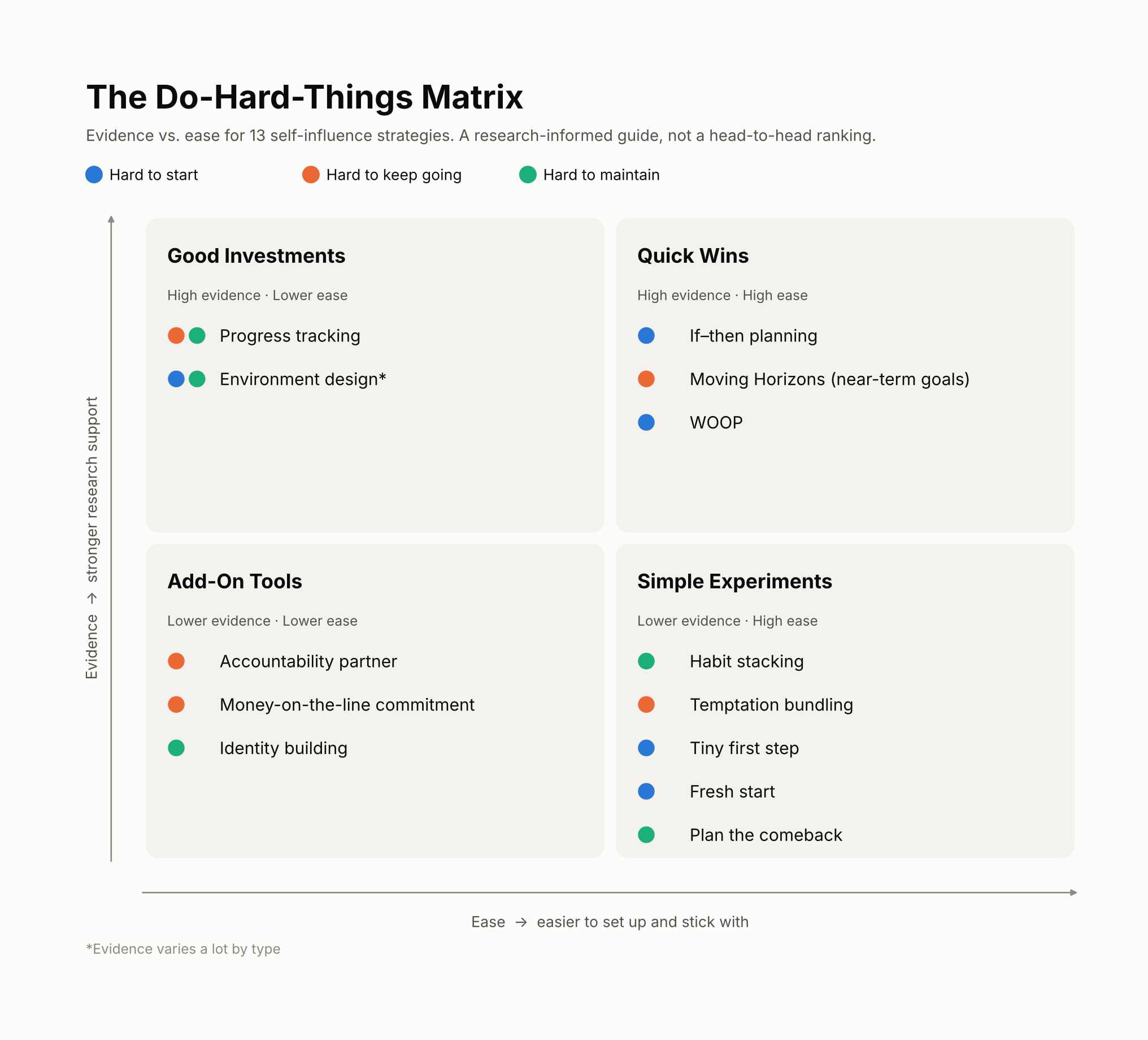
A quick note on how to read this. Treat it as a research-informed guide. Some strategies have strong evidence for a modest effect. Some have exciting ideas behind them and very little direct testing. And the best strategy is always the one that matches your kind of hard. A quick win for starting won't help much if your real problem is maintaining something hard.
Type 1: 🔵 Hard to start
This is the initiation problem. You know exactly what to do. Write the article. Make the call. Go for the run. And somehow, you do something else.
A few things are usually going on. The reward is far away and the discomfort is right now. The first step may be fuzzy and something easier is within reach.
Quick Wins
If–then planning. Peter Gollwitzer named these implementation intentions. Instead of "I'll work on the proposal this week," you decide when, where, and how: "If it's 7:30 on Monday, then I'll open the proposal and write for 10 minutes."
This is one of the best-studied tools in all of behavior change. Gollwitzer and Paschal Sheeran's 2006 meta-analysis of 94 tests found a medium-to-large effect on reaching goals. In 2025, Sheeran and colleagues analyzed 642 tests and found effects ranging from small to medium-large depending on what was measured. The plans worked best when they used a true if–then format, when people actually cared about the goal, and when they rehearsed the plan.
Why does it work? You’ve made the decision before the situation. When 7:30 Monday arrives, your brain recognizes the cue and the response is already decided upon. There's nothing left to negotiate.
Application:
Write the plan down in the exact format: "If [situation], then I will [action]."
Pick a cue you can't miss: a time, a place, or the end of something you already do.
Say it to yourself once or twice. Rehearsal made the plans stronger.
WOOP. Gabriele Oettingen spent years studying positive fantasies, and found that daydreaming about success can actually drain the energy you need to chase it. Her fix is WOOP: Wish, Outcome, Obstacle, Plan. You picture the good outcome, then name the inner obstacle most likely to stop you ("I'll feel tired and scroll instead"), then make an if–then plan for it.
A 2021 meta-analysis of 24 effects and nearly 16,000 people found a small-to-medium effect on goal attainment, likely a bit smaller after adjusting for publication bias. Not magic. But it takes five minutes, and it's honest about the part most plans ignore: you.
Simple Experiments
Make the first step tiny. One sentence. Shoes on. Open the slide deck. This one makes intuitive sense, and it borrows from the research on small, near-term goals.
Pick a fresh start. Ever notice how packed the gym is in January? Hengchen Dai, Katy Milkman, and Jason Riis named this the fresh start effect. At one university gym, the odds of a visit jumped about 33% at the start of a week and 47% at the start of a semester, and rose after people's birthdays. On stickK, a site where people sign goal contracts, new contracts more than doubled at the start of a new year. New beginnings seem to put the old, imperfect you in the past.
Most of that evidence comes from watching what people already do, so it shows a pattern. It can't prove that picking a date causes the change. But one experiment points the same way. When more than 6,000 university employees were invited to start saving for retirement on a "fresh start" date, like New Year's Day or their birthday, about 50% more of them enrolled than when the date was simply a few months away.
You've probably heard that "I'll start Monday" rarely works. Both can be true. Monday as an excuse to skip today is procrastination in a nice outfit. Monday with a plan attached is a real starting line. If you can start today, start today. If you're going to wait anyway, make the date mean something.
Application:
Give your start a landmark: next Monday, the 1st of the month, the day after a trip.
Mark it as a new chapter: "Starting Monday, I write before I open email."
Pair it with an if–then plan, so the fresh start comes with a first step.
Good Investments
Change the room. Clothes beside the bed. The doc already open. The phone in another room. Environment design is a huge category, and the evidence varies a lot by type. Defaults and making the good choice the easy choice tend to hold up best. Pure "here's some information" nudges hold up worst. One honest note: a big 2022 nudge meta-analysis was later challenged for publication bias, so be skeptical of anyone who tells you nudges always work.
Type 2: 🔴 Hard to keep going
This is the persistence problem. You started. Now it's uncomfortable, progress is slow, and you can't see the end.
Quick Wins
Moving Horizons. Rich explained it to me this way. In any situation, your brain is trying to figure out three things: duration (how long will this last?), pathway (what's my way through?), and outcome (what's the end state?). When you can't answer one or more of those, stress goes up.
So you create your own answers. Rich's version on the beach: "Duration, from now until end of sand berm. Pathway, from here to end of sand berm. And outcome, end of sand berm." Get there. Notice it. Pick the next one.
He also gave me a line I wrote down: "The past is history, the future is fiction." Anxiety lives in the fiction. The horizon keeps you in the part you can actually control.
I've done this without knowing it had a name. I grew up in Singapore, where military service is mandatory. In one exercise, they blindfolded us and dropped us into the deep end of a pool. I remember thinking, very clearly, I'm going to die here. Then, almost by accident, I focused on one thing. Can I reach the bottom and push myself up? That was it. That was my horizon. (I still don't love deep water, by the way.)
Here's the honest science part. Moving Horizons is Rich's name for a near-term goal you set in the moment, and the near-term goal part is well researched. In Bandura and Schunk's 1981 study, kids with small session-by-session goals finished 74% of the math material, compared with 55% for kids with one big distant goal. They also became more persistent on hard problems. The distant goal, in the authors' words, "had no demonstrable effects." Rich's in-the-moment version, with its duration, pathway, and outcome, hasn't been tested directly. But it stands on solid ground.
Application:
When you want to quit, name the next horizon out loud: the next paragraph, the next streetlight, the next 15 minutes.
Give it a duration, a pathway, and an outcome. "Ten minutes. This outline. Three bullet points done."
If you're too wound up to even pick one, make the first horizon your breath. Rich's suggestion: take five or ten slow breaths first.
Simple Experiments
Temptation bundling. Katy Milkman's idea: only let yourself have a "want" while you do a "should." In her first study, gym members who could only listen to gripping audiobooks at the gym went about 51% more often at first. The effect faded over time, especially after Thanksgiving. A much larger follow-up with almost 6,800 people found a smaller lift: about 10–12% more workouts per week. Modest, but real.
Good Investments
Make progress visible. Benjamin Harkin and colleagues analyzed 138 studies with almost 20,000 people. Getting people to monitor their progress helped them reach their goals. Two details matter. The more often people checked, the better. And the effect was even stronger when progress was physically written down or reported to someone else.
One more nuance worth knowing: tracking the behavior changed the behavior, and tracking the result changed the result. If you want to write more, count sessions. Counting followers measures something else entirely.
Add-on Tools
Put something on the line. In a study in the Philippines, Dean Karlan and colleagues offered smokers a savings account. They deposited money, and if they failed a nicotine test after six months, they lost it. Only about 11% signed up. Those offered the account were 3 to 6 percentage points more likely to pass the test. Most still didn't quit. Commitment devices can work, but they're a tool for specific moments, and most people don't want them.
Type 3: 🟢 Hard to maintain
This is the consistency problem. You've done it. You know you can. Then the novelty fades, the calendar fills up, and it slips.
This is the hardest of the three. Remember the gym megastudy: plenty of programs worked for four weeks, and almost none kept working after.
Simple Experiments
Habit stacking. "After I pour my coffee, I write one paragraph." Habits form when the same cue keeps triggering the same behavior. That's why the cue matters so much.
In a small study on flossing, Gaurav Judah and colleagues had people floss either before or after brushing their teeth. The after-brushing group built a stronger habit, and eight months later they were flossing more often. It was a small study, so treat it as a promising signal. But it captures the idea: hook the new thing onto the end of something you already do.
Plan the comeback. In the gym megastudy, the single best program gave people a small reward for returning after they missed a workout. And in Phillippa Lally's habit study, missing one day didn't derail anyone. One missed day is normal. What matters is how fast you come back.
Application:
Pick an anchor you already do every day without thinking: coffee, brushing your teeth, closing your laptop.
Write "After I [anchor], I will [new behavior]."
Decide now what happens after a miss: "If I skip, I restart at the very next anchor. No catching up."
Good Investments
Let your reps build the identity. "I'm someone who writes." "I'm someone who keeps promises to myself." This is popular advice, and it rhymes with real psychology. Daryl Bem's self-perception theory suggests we often figure out who we are by watching what we do. Daphna Oyserman's work on identity-based motivation shows structured programs that connect identity to action can change behavior.
But here's the catch. I couldn't find good evidence that repeating an identity statement on its own changes much. One famous study found that asking people to "be a voter" boosted turnout more than asking them "to vote." A larger replication didn't find the effect. So the order matters. Do the thing, then let it count as evidence of who you are.
Add-on Tools
Borrow an identity for the hard moment. There's a fun twist on this. In 2017, Rachel White, Angela Duckworth, Ethan Kross and their colleagues gave 180 kids, ages 4 to 6, a boring 10-minute computer task. An iPad sat nearby, tempting them to quit. Some kids were asked to think about themselves: "Am I working hard?" Others got a prop and became a hard worker they admired, like Batman or Dora the Explorer: "Is Batman working hard?"
The Batman kids stuck with it the longest. Six-year-olds playing a character stayed on task about 55% of the time. Six-year-olds thinking about themselves managed about 35%.
Researchers call it the Batman effect. Performance coach Todd Herman wrote a whole book on the grown-up version, The Alter Ego Effect: stepping into a character so the hard thing feels less like a referendum on you.
Two caveats. That study was with young children on one task, and no one is sure exactly why it works. The closest adult research comes from Ethan Kross on self-distancing: people who coached themselves by name ("Howie, you've got this") instead of "I" felt less anxious before giving a speech. So treat an alter ego as a tool for getting through the hard moment. The reps are what make the identity yours.
Application:
Before the hard thing, ask: "What would [the person I'm becoming] do right now?"
Pick a character you admire for this exact behavior, and give yourself a cue to step into it: a song, a jacket, a ritual.
Talk to yourself by name in the tough moment, the way a coach would.
Your playbook
Diagnose. A professional of influence starts with the behavior. Is this hard to start, hard to keep going, or hard to maintain? Be honest. which hard is it?
Pick one tool from the matching type. Begin with the Quick Wins and Simple Experiments. Reach for the Good Investments and Add-On Tools only if the easy ones don't do the job.
Run it on one behavior for one week. Write down what happened. Then adjust.
🔥 IN CASE YOU MISSED IT
This one mistake is quietly costing you chances in your career.
Every person you meet could change your life. But most of us waste that chance in the first 3 seconds. It happens when someone asks: “So, what do you do?”
→ See the LinkedIn post (4,747 people read this)
🤔 REFLECTIONS
This is something I deeply feel—whether you think you can or you can’t, you are right. I remember feeling deeply self-conscious and intimidated when I was applying to my MBA program years ago. As I was looking through a brochure and reading all the accomplishments of past students “30 under 30 Forbes list, Youngest stockbroker, excited 2 companies…” I simply didn’t feel like I was good enough.
But I applied and interviewed anyway. I got in. And when I arrived and graduated, I never once felt like I was less than the other students. We all brought different perspectives, ideas, and skills.
My message to you: you belong at the table, never worry about what you bring.
Professionals of influence, I’ll see you next Sunday! 😉
Warmly,
Howie
References
Why "try harder" keeps failing
Milkman, K. L., et al. (2021). Megastudies improve the impact of applied behavioural science. Nature. doi:10.1038/s41586-021-04128-4 More than 61,000 gym members, 54 programs designed by 30 scientists. 45% of the programs increased gym visits, only 8% kept working after they ended, and the winner rewarded people for coming back after a missed workout. Judges couldn't reliably predict which programs would work.
Hard to start
Gollwitzer, P. M., & Sheeran, P. (2006). Implementation intentions and goal achievement: A meta-analysis of effects and processes. Advances in Experimental Social Psychology. doi:10.1016/S0065-2601(06)38002-1 The classic review of if–then plans: 94 tests, with a medium-to-large effect on reaching goals.
Sheeran, P., Listrom, O., & Gollwitzer, P. M. (2025). The when and how of planning: Meta-analysis of the scope and components of implementation intentions in 642 tests. European Review of Social Psychology. doi:10.1080/10463283.2024.2334563 A much bigger update. If–then plans still work, with effects from small to medium-large depending on the outcome. They work best in true if–then format, when people care about the goal, and when they rehearse the plan.
Kappes, H. B., & Oettingen, G. (2011). Positive fantasies about idealized futures sap energy. Journal of Experimental Social Psychology. Daydreaming about success can lower the energy you have to go after it. This is the problem WOOP was built to solve.
Wang, G., Wang, Y., & Gai, X. (2021). A meta-analysis of the effects of mental contrasting with implementation intentions on goal attainment. Frontiers in Psychology. doi:10.3389/fpsyg.2021.565202 WOOP across 24 effects and nearly 16,000 people: a small-to-medium boost, probably a bit smaller after correcting for publication bias. It worked better when someone guided people through it.
Dai, H., Milkman, K. L., & Riis, J. (2014). The fresh start effect: Temporal landmarks motivate aspirational behavior. Management Science. doi:10.1287/mnsc.2014.1901 Gym visits, "diet" searches, and goal contracts all jump after "new beginning" dates like Mondays, new semesters, birthdays, and New Year's. This shows a pattern in real-world data, so it can't prove the date causes the change.
Beshears, J., Dai, H., Milkman, K. L., & Benartzi, S. (2021). Using fresh starts to nudge increased retirement savings. Organizational Behavior and Human Decision Processes. doi:10.1016/j.obhdp.2021.06.005 A field experiment with more than 6,000 university employees. Offering a "fresh start" date to begin saving led to about 50% more enrollment than a plain future date.
Mertens, S., et al. (2022). The effectiveness of nudging: A meta-analysis of choice architecture interventions across behavioral domains. PNAS. doi:10.1073/pnas.2107346118 A large review that found nudges work, with changes to the choice itself (like defaults) doing better than simply giving people information.
Maier, M., et al. (2022). No evidence for nudging after adjusting for publication bias. PNAS. A reply to Mertens arguing that once you correct for the studies that never got published, the overall nudge effect disappears. Read these two together.
Hard to keep going
Bandura, A., & Schunk, D. H. (1981). Cultivating competence, self-efficacy, and intrinsic interest through proximal self-motivation. Journal of Personality and Social Psychology. doi:10.1037/0022-3514.41.3.586 40 kids who struggled with math. Those with small session-by-session goals finished more of the material, grew more confident, and about 90% chose extra math in their free time, compared with about 40% in the other groups. It's a small study, but a classic.
Harkin, B., et al. (2016). Does monitoring goal progress promote goal attainment? A meta-analysis of the experimental evidence. Psychological Bulletin. doi:10.1037/bul0000025 138 studies, almost 20,000 people. Tracking progress helps people reach goals, especially when they check often and when progress is written down or reported to someone.
Milkman, K. L., Minson, J. A., & Volpp, K. G. M. (2014). Holding the Hunger Games hostage at the gym: An evaluation of temptation bundling. Management Science. doi:10.1287/mnsc.2013.1784 The original temptation bundling study. Gym-only audiobooks boosted visits by 51% at first, but the effect faded over time.
Kirgios, E. L., et al. (2020). Teaching temptation bundling to boost exercise: A field experiment. Organizational Behavior and Human Decision Processes. doi:10.1016/j.obhdp.2020.09.003 A much larger follow-up with about 6,800 people. A smaller but real lift of about 10–12% more weekly workouts.
Giné, X., Karlan, D., & Zinman, J. (2010). Put your money where your butt is: A commitment contract for smoking cessation. American Economic Journal: Applied Economics. doi:10.1257/app.2.4.213 Smokers in the Philippines could bet their own money on quitting. Only 11% signed up, and those offered the contract were 3 to 6 percentage points more likely to pass a nicotine test. It worked, but for few people.
Hard to maintain
Lally, P., van Jaarsveld, C. H. M., Potts, H. W. W., & Wardle, J. (2010). How are habits formed: Modelling habit formation in the real world. European Journal of Social Psychology. doi:10.1002/ejsp.674 Habits took anywhere from 18 to 254 days to feel automatic, and missing a single day didn't derail the process. The researchers tracked people over time and didn't run an experiment.
Judah, G., Gardner, B., & Aunger, R. (2013). Forming a flossing habit: An exploratory study of the psychological determinants of habit formation. British Journal of Health Psychology. 50 people. Flossing after brushing built a stronger habit than flossing before, still visible eight months later. A small, early study.
Bem, D. J. (1972). Self-perception theory. Advances in Experimental Social Psychology. The idea that we often learn who we are by watching what we do.
Oyserman, D., Bybee, D., & Terry, K. (2006). Possible selves and academic outcomes: How and when possible selves impel action. Journal of Personality and Social Psychology. A structured program that linked students' future identities to concrete actions improved their school results. Structure was the key ingredient. Affirmations alone weren't tested.
Bryan, C. J., Walton, G. M., Rogers, T., & Dweck, C. S. (2011). Motivating voter turnout by invoking the self. PNAS. Asking people to "be a voter" increased turnout more than asking them "to vote."
Gerber, A. S., Huber, G. A., Biggers, D. R., & Hendry, D. J. (2016). A field experiment shows that subtle linguistic cues might not affect voter behavior. PNAS. A much larger test of the "be a voter" idea didn't find the effect.
White, R. E., Prager, E. O., Schaefer, C., Kross, E., Duckworth, A. L., & Carlson, S. M. (2017). The "Batman effect": Improving perseverance in young children. Child Development. 180 kids aged 4 to 6. Kids who pretended to be a hard-working character stayed on a boring task longer than kids who thought about themselves. One study, with young children.
Kross, E., et al. (2014). Self-talk as a regulatory mechanism: How you do it matters. Journal of Personality and Social Psychology. Coaching yourself by name, the way you'd talk to a friend, lowered anxiety before a stressful speech.
Herman, T. (2019). The Alter Ego Effect. A popular book on using a chosen character to perform under pressure. Practical ideas, but it isn't research.