A Talk-Line, a plastic turkey, and 45 years
There is a turkey company that runs a phone line where you can’t buy a turkey.
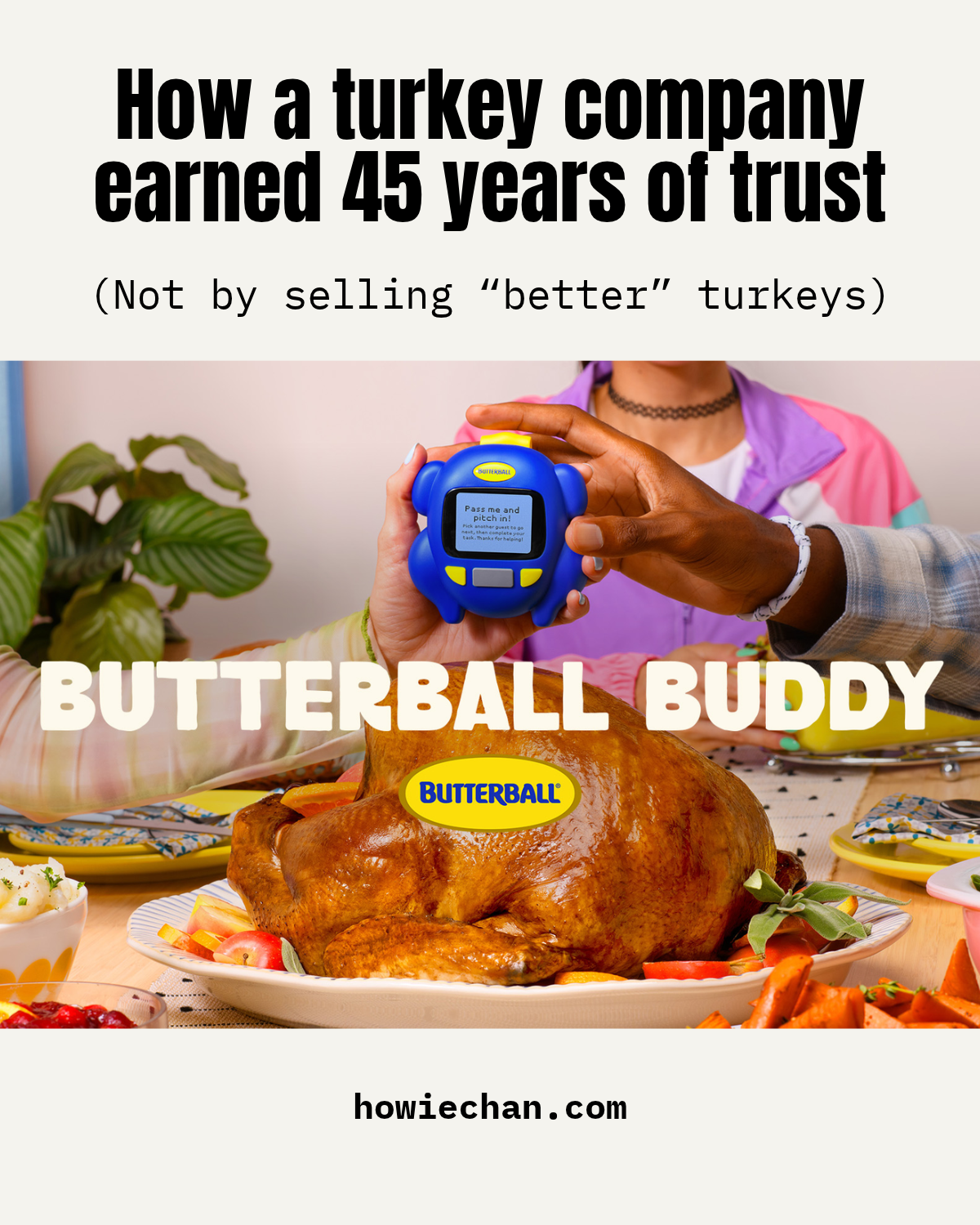
And this year, it gave away a plastic turkey…
Sounds like bad business. Stay with me.
Butterball has a strange problem. You buy its product once a year, for the most stressful meal of the year, in front of the people you most want to impress.
If the turkey goes wrong, Thanksgiving goes wrong.
That's a lot riding on one bird.
So in 1981, Butterball did something odd. It put six home economists on a phone line to answer one question: "Help, what do I do with this turkey?"
They took about 11,000 calls that first season.
2026 is the Talk-Line's 45th season. More than 50 experts now answer over 100,000 questions every November and December, in English and Spanish.
One of Butterball's top sales and marketing execs said the calls are "less culinary and more psychological." A lot of the job is calming people down.
This year, Butterball went further. A survey it shared found 85% of hosts would rather guests offer to help, but only 38% of guests ask.
So Butterball made the Butterball Buddy, a free plastic turkey that hands out chores so the host doesn't have to ask.
The Talk-Line's number is printed on the back.
Neither one sells a turkey. Both have earned Butterball 45 years of trust.
Which brings us to this week's question: How do you get people to choose you without selling anything?
⚡️ 60 SEC INFLUENCE
When in doubt, deliver help
Help first. Help at the moment they're most scared. And help with the problem behind the problem.
The people you serve rarely lose sleep over the task itself. A new VP worries about looking lost in front of the CEO. A founder worries about the board meeting going sideways. A new leader worries about looking bad in front of their new team.
For Butterball, their customer’s task is the turkey. Their fear is the ruined day.
So find the moment that fear peaks and show up with something useful, but ask for nothing.
There are two forces at work here.
The first is reciprocity. Robert Cialdini's research shows we feel a pull to give back to whoever helped us first. On the Talk-Line, Butterball helps and asks for nothing. That's exactly why it works.
The second is uncertainty reduction. Communication researchers Charles Berger and Richard Calabrese found that uncertainty pushes us to look for answers, and we warm up to whoever gives them.
Help that arrives at the scary moment addresses both at once. You give first, and you give the answer they were desperately looking for.
TRY THIS
Write down your clients', your customers’, your bosses’ "Thanksgiving morning," the three moments they panic the most. (The first 90 days in a new role. The week before a big presentation. Review season. A reorg.)
Pick one. Make one simple tool for it: a checklist, a script, a one-page guide. Make it so useful that someone could solve the problem without you.
Put your name and how to reach you at the bottom. Then send it to three people who are about to hit that moment.
That's your Talk-Line.
As promised, influence in 60 seconds.
The Influence Anyone podcast:

3 out of 4 people think they're more trustworthy than average. (The math doesn't work.) If you want to know how trust actually gets built, this one's for you. Jay Clouse, founder of Creator Science, shares:
The four traits people judge before they trust you
The eight-year habit he didn't realize was building trust
Why copying his exact systems didn't work for someone else
🔎 DEEP DIVE
Most experts have the order backwards.
They wait for someone to become a client, and then they help. Butterball spent 45 years doing the reverse. It helps millions of people who already bought the turkey, and millions more who might buy a different brand next year.
The result is trust you can't buy with ads. Here's the science behind it, and how a person of influence can use it.
1. Help before you sell.
This is reciprocity, one of the most studied forces in human behavior.
In a classic 1971 study, psychologist Dennis Regan had people rate paintings alongside another "participant" named Joe, who was actually working for the researcher. During a break, Joe left and came back with two Cokes, one for himself and one for the participant. Later, Joe asked if they'd buy some raffle tickets.
People who got the Coke bought about twice as many tickets as people who didn't. A 10-cent soda created a debt people wanted to repay. (A Coke in 1971 only cost 10 cents!)
Cialdini found that reciprocity works best when the gift is meaningful, unexpected, and personal. A Talk-Line call checks all three boxes. It solves a real problem, it's free, and it's about your turkey and your family.
Application:
Hold "office hours." Block one free 30-minute slot a month that anyone in your network can book with one question. No pitch, and no follow-up unless they ask for it.
Answer the panic question in public. Take the question clients ask you most, word for word, and answer it fully in a post or email.
Have the no-pitch conversation. On my podcast, Jay Clouse shared how he starts these calls: "Hey, no pressure. I'm not going to pitch you on anything." Then he just asks what's getting in their way. He says about half the people he talks to end up buying.
Inside your company, become the person people call before the big meeting. Offer a 15-minute dry run to a peer or junior leader before they present to the executive team.
2. Show up at the moment of fear.
Berger and Calabrese's uncertainty reduction theory says that when we don't know what will happen, we feel uneasy, and we go looking for answers. Whoever reduces that uncertainty earns our warmth and trust.
Timing is everything here. Butterball's advice is just as good in July. But the problem is nobody feels the anxiety in July.
Every client you serve has their own Thanksgiving morning. The trick is knowing when it is.
Application:
Map the panic points. Write down the predictable moments your clients get scared: promotions, first 90 days, board season, budget planning, layoffs, a first keynote.
Time your help to those moments. Send the "first week as a new VP" checklist the week promotions are announced. Share "how to present to the board" right before board season.
When you hear someone got promoted, reorganized, or laid off, send one useful thing within 48 hours, like a template or a question to ask their new boss. Skip "Congrats, let me know if I can help."
3. Solve the problem behind the problem.
Harvard professor Clayton Christensen called this the "job to be done." In his famous milkshake research, he found that many morning milkshake buyers were "hiring" the shake to make a long, boring commute bearable. The real job had little to do with being hungry.
Butterball understands its job. The Talk-Line fixes the cooking. The Buddy fixes the hosting. Both protect the day.
Your clients come to you asking for a better deck, a sharper LinkedIn profile, or a leadership plan. Underneath, they want to feel confident in front of the people who matter to them.
Application:
Name the real fear. When a client asks for a better slide deck, ask, "What are you worried will happen in that room?" Then help with that answer too.
Make your Buddy. Build one simple tool that handles the awkward human part: a script for asking your boss for the stretch project, a one-page "what to say in your first team meeting," or a checklist for walking into a room where you're the least senior person. Put your name and how to reach you at the bottom, the same way Butterball printed the Talk-Line on the back.
Four mistakes that turn free help into a turnoff
"Let me know if I can help." It sounds generous, but it puts the work on the scared person. Butterball's Buddy exists because guests don't offer and hosts don't ask. Offer something specific. (Watch this reel: I share what to say instead)
Helping at the wrong time. Great advice in the wrong month gets ignored.
Strings attached. A "free strategy call" that turns into a sales pitch breaks the trust you were trying to build. People can tell the difference between a gift and a hook.
Fixing only what’s on the surface. Solve the task and you're useful. Solve the fear and you become trusted.
A note on ethics
Reciprocity is powerful, which is why it's easy to abuse. The test is simple: would your help still be worth it if they never hired you? If yes, you're building trust. If no, you're setting a trap, and people eventually notice.
Butterball's Talk-Line passes the test. That's why it's lasted 45 years.
Help first. Show up when it's scary. Solve the problem behind the problem.
That's how a turkey company earned 45 years of trust, and it's how a person of influence like you can too.
References
Berger, C. R., & Calabrese, R. J. (1975). Some explorations in initial interaction and beyond: Toward a developmental theory of interpersonal communication. Human Communication Research, 1(2), 99–112.
Christensen, C. M., Hall, T., Dillon, K., & Duncan, D. S. (2016). Competing Against Luck: The Story of Innovation and Customer Choice. HarperBusiness.
Cialdini, R. B. (1984). Influence: The Psychology of Persuasion. William Morrow.
Regan, D. T. (1971). Effects of a favor and liking on compliance. Journal of Experimental Social Psychology, 7(6), 627–639.
Butterball Talk-Line history, call volume, exec quote, and host survey: PR Newswire, Independent
🤔 REFLECTIONS
This past week was Thanksgiving in the US. And I’m truly grateful for:
A loving family with no drama
My health and the ability to move and exercise
Friends who make me laugh and feel loved
New members of the Behavioring Lab for trusting in me
It’s a few more weeks till the end of 2026, and I’m so excited for all the projects I have lined up. Here’s to you and your family. Grateful for all you readers out there!
I’ll see you next Sunday!
Influence for good 🤘🏽,
Howie Chan
Creator of Influence Anyone